
Want to learn more about the CST Guide and how to use it?
Join a CST Voter Guide Training Session!
Catholics are called to bring their faith into public life.
This guide, being one way to help Catholics do just that, is inspired, in part, by Pope Francis’s description of the concerns of preeminent priority to consider as we prepare to vote:
“Our defense of the innocent unborn, for example, needs to be clear, firm, and passionate, for at stake is the dignity of a human life, which is always sacred and demands love for each person, regardless of his or her stage of development. Equally sacred, however, are the lives of the poor, those already born, the destitute, the abandoned and the underprivileged, the vulnerable infirm and elderly exposed to covert euthanasia, the victims of human trafficking, new forms of slavery, and every form of rejection.”
(Pope Francis, “Gaudete et Exultate” No. 101, 2018)
Here are ways to start bringing your faith into public life:
Invest time in assessing candidates’ positions on issues, the policies they support, and their integrity and strength of character.
Respond to the CST principle of “call to participation” by carefully discerning which candidates to support.
Strive to be “political” i.e., engaged in government - not partisan (USCCB).
Prioritize the U.S. Bishops’ call to always ask, “Who is my Neighbor?”
As Catholics, we need to assess a candidate’s whole character, as well as their policies.
Elected officials will face unknown challenges and crises. We cannot know their precise positions on future crises.
We must assess each candidate’s judgment and willingness to take guidance from experts. We know from prior crises that it is critical to choose candidates who have the prudence and humility to seek wise counsel, to make decisions with concern for all lives, balancing liberty and justice, choosing peace over violence, and promoting the common good.
We seek candidates who strive for unity and who recognize that among our diverse citizenry, we have more in common as people made in the image and likeness of God than anything that might divide us.
This Voter Guide is Divided into Four Sections
Introduction
Criteria for assessing candidates’ Moral Character and the Qualities of a Virtuous Politician
Forming Conscience
The Seven Principles of CST – two pages per principle - which include:
Definition of the CST principle from the USCCB Website
Scripture
Doctrinal Tradition (i.e., Magisterium, Vatican II, Papal Encyclicals, Catechism)
Saints and Holy Figures
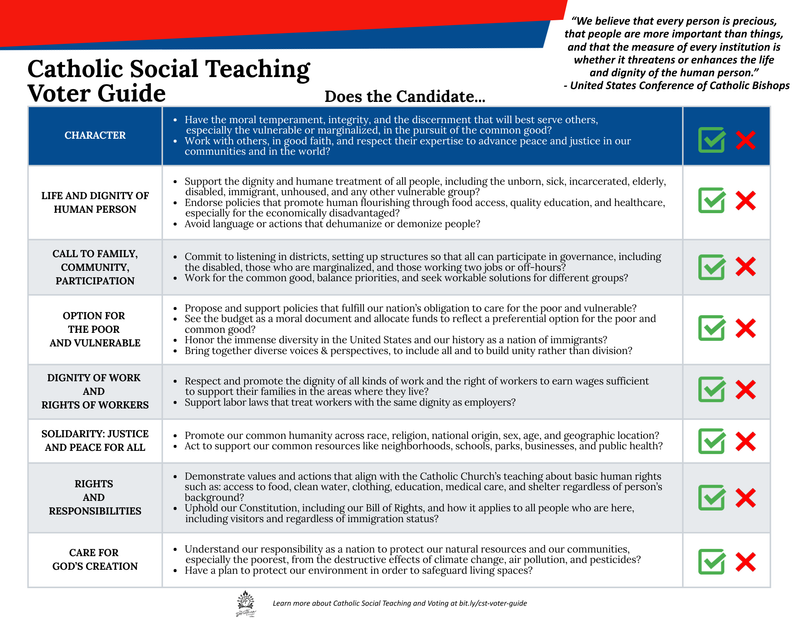
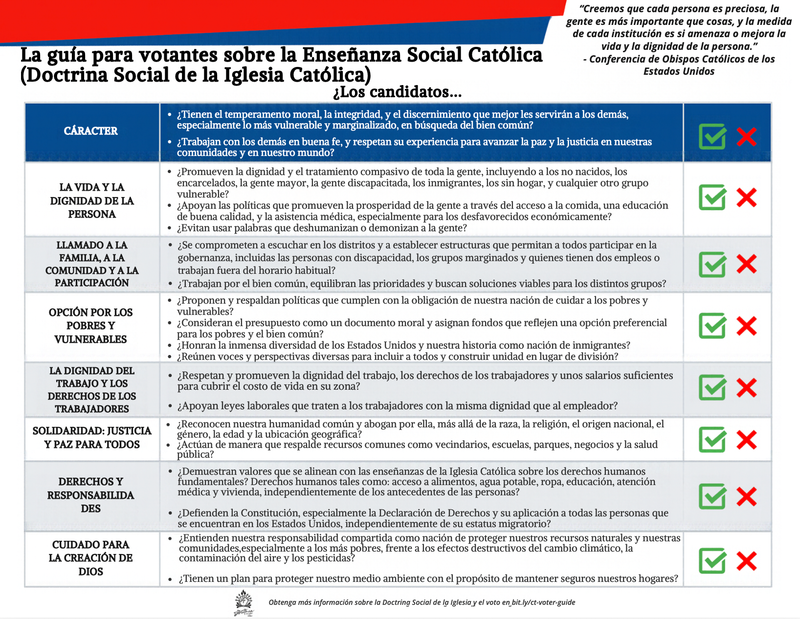
Candidate Assessment Questions
There are many ways to engage with the guide, and we recommend the following steps:
Learn about what it means to form your conscience as a faithful Catholic
Dive into the Seven Themes of Catholic Social Teaching
Conduct a personal examen based on Catholic Social Teaching
Assess your candidates as they relate to Catholic Social Teaching
Resources
CST Voter Guide Support Materials
Check out these helpful resources to support you and your community in bringing our Catholic faith into the public life.
The Personal Examen focuses on how we can personally live out Catholic Social Teaching.
The Small Group Discussion Questions are focused on facilitating conversations using the Voter Guide.
And the Discernment for Faithful Participation Aid is similar to the Voter Guide but focused on education and personal formation rather than candidate assessment.


Live your faith out loud